What Does a Ritual Candle Flame Really Mean?
A tall flame means success.
A crackling flame means someone is thinking about you.
If the candle goes out, the ritual is blocked.
You can find interpretations like these almost everywhere in modern esoteric content.
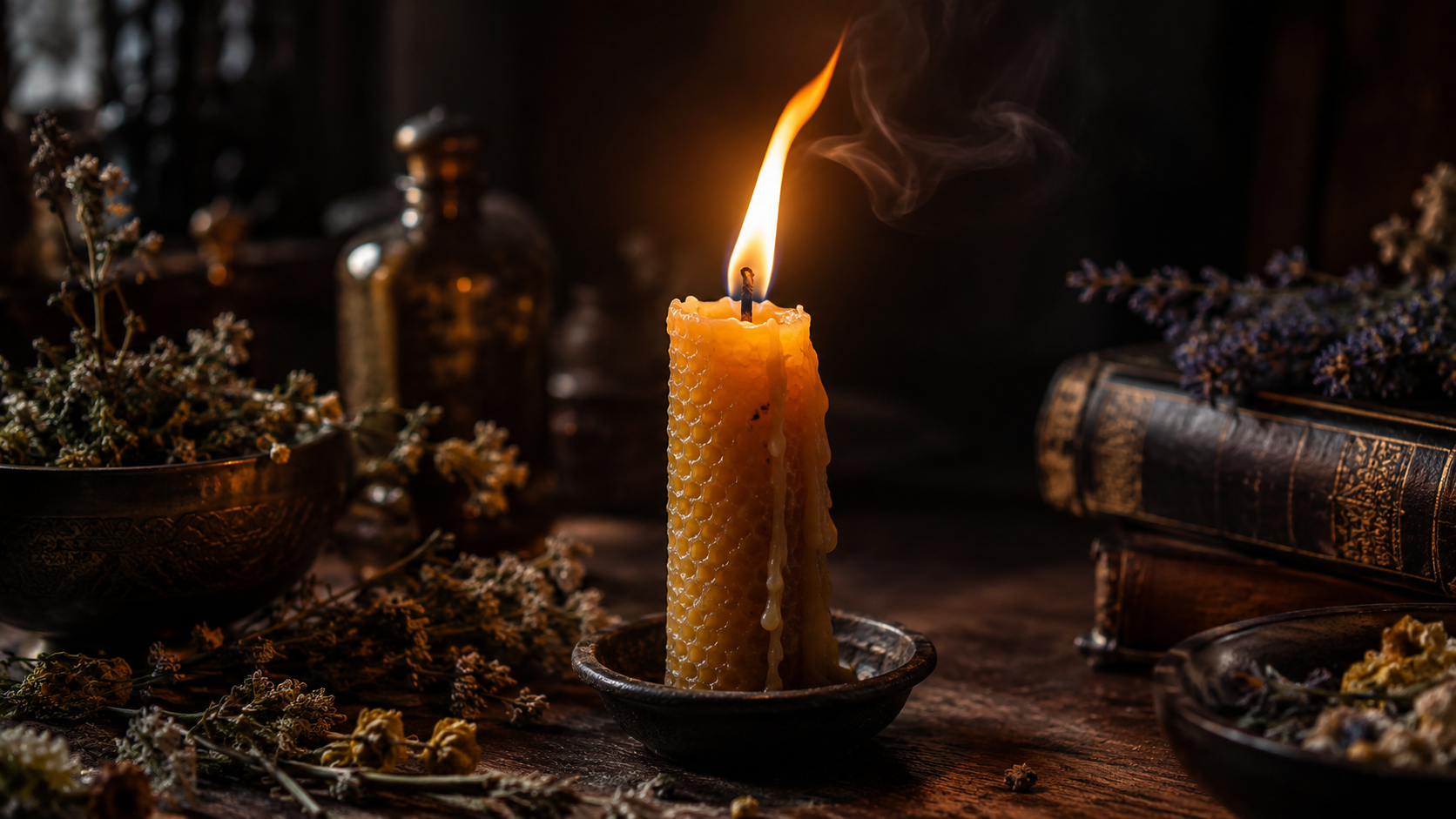
But historical traditions of divination by fire were far more complex. There is also another part of the story that is often overlooked: a candle is a physical system. Its flame reacts to air, heat, wick size, wax composition, and the materials around it.
So before interpreting a candle flame, it helps to separate two things:
what is happening physically and what we choose to interpret symbolically.
People Really Did Read Fire
Divination by fire is not a modern invention.
In the ancient world, fire, smoke, and the behaviour of flames could be observed as part of religious and divinatory practices.
In ancient Greek ritual, for example, the way a sacrificial fire burned could be interpreted as a sign. The movement of flames, smoke, and the behaviour of offerings placed in the fire could all become part of divination.
Over time, different practices came to be described by different terms.
Pyromancy
Pyromancy is divination through fire.
Lychnomancy
Lychnomancy refers more specifically to divination by observing the flame of a lamp or other light source.
Ceromancy
Ceromancy is divination using wax.
Traditionally, one of its best-known forms involved pouring melted wax into water and interpreting the shapes that appeared as the wax cooled.
This distinction matters because modern “candle flame reading” often combines several practices that were not historically one single system.
Why Does a Candle Flame Move?
A burning candle may look simple, but it is actually a small and sensitive combustion system.
The flame depends on several factors:
- the amount of fuel reaching the flame through the wick;
- the thickness and length of the wick;
- the composition of the wax;
- the movement of surrounding air;
- temperature;
- the shape and diameter of the candle;
- colourants, herbs, and other materials added to the candle.
Even a very weak draft can make a flame lean, dance, flicker, or suddenly become larger.
A wick that is too long may create a larger flame. A change in airflow may make the flame move dramatically. Herbs or other materials close to the wick can also change the way the candle burns.
So a flame that suddenly becomes tall is not automatically evidence of “strong energy”.
Sometimes, the air in the room simply changed.
What If the Candle Crackles?
Crackling is another behaviour that often receives an immediate symbolic interpretation.
But there are several physical reasons why a candle may crackle.
Moisture, small particles, herbs, or other materials near the wick can react to heat and produce sounds, sparks, or sudden changes in the flame.
This is especially important with herbal ritual candles.
Plant material does not burn in exactly the same way as wax. If herbs, flowers, or other botanical ingredients enter the flame, they may ignite separately and briefly increase the size of the flame.
They may also create sparks.
For this reason, unusual flame behaviour should always be considered from a safety perspective first and interpreted symbolically only afterwards.
Can You Still Read a Candle?
Yes.
But it helps to understand what candle reading actually is.
Divination is not a laboratory measurement. It is a symbolic system of interpretation.
Within a particular magical, spiritual, or folk tradition, certain behaviours of a flame may be interpreted as meaningful signs.
The problem begins when these interpretations are presented as universal laws.
There is no single historical dictionary stating that every tall flame always means one thing, every low flame another, and every extinguished candle something else.
Different traditions developed different symbolic languages.
So instead of asking:
“What does a tall flame mean?”
it may be more useful to ask:
“What does this observation mean within the tradition or symbolic system I am working with?”
That is a much more precise question.
And What About the Wax?
Wax divination has a clearer historical identity.
In practices generally described as ceromancy, melted wax is poured into water and the resulting shapes are interpreted.
The wax does not need to be understood as literally “speaking”.
Instead, randomly created forms become material for symbolic interpretation.
In that sense, ceromancy is closer to reading images, patterns, and associations than to physically measuring the future.
Observe First. Interpret Second.
Ritual practice does not become less meaningful when we recognise the physical behaviour of fire.
Quite the opposite.
A flame can be both fire and symbol.
Wax can be both material and a tool of divination.
A candle can react to a draft while that same movement becomes meaningful within the symbolic language of a ritual.
One explanation does not automatically destroy the other.
The important thing is knowing where observation ends and interpretation begins.
Watch the flame first.
Understand what may be happening physically.
And only then decide whether what remains has meaning within your own ritual tradition.